Video is loading...
In order to see the video, click the Privacy icon in the lower left corner of your screen to grant consent for YouTube Video.
The Privacy icon looks like this:

|
Event
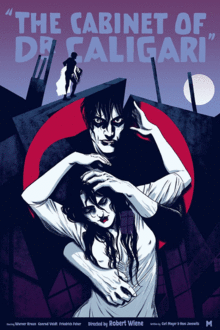
The Cabinet of Dr Caligari
At a carnival in Germany, Francis (Friedrich Feher) and his friend Alan (Rudolf Lettinger) encounter the crazed Dr. Caligari (Werner Krauss). The men see Caligari showing off his somnambulist, Cesare (Conrad Veidt), a hypnotized man who the doctor claims can see into the future. Shockingly, Cesare then predicts Alans death, and by morning his chilling prophecy has come true making Cesare the prime suspect. However, is Cesare guilty, or is the doctor controlling him?
Considered by many to be the first true horror film, The Cabinet of Dr. Caligari (1920) not only holds that title, but exists as the quintessential definitive piece of German expressionist cinema. Its visual style is the pinnacle of the genre, with its crooked backdrops, harsh lines, painted shadows, and surreal nature permeating every scene. Distortions and mangled perspectives are constant, bold brush strokes paint shadows equally with sharp edges and round curves, as lines and structures twist and strike to form nightmarish shapes. Its horror shot within the bosom of an artistic combination that brings to mind Edvard Munch, MC Escher and Picasso, but lives on as definitively Caligari. After nearly 100 years, its twisted and bizarre visual style is unmatched, positioning the film as a staple in film history studies and examinations of early cinematic pioneers.
Robert Wiene
German expressionist director who began his career in the theater, entered films as a scenarist and is best known for the expressionist classic, The Cabinet of Dr. Caligari (1919). Wiene was the second choice to direct the film (producer Erich Pommer originally offered the job to Fritz Lang), which was scripted by Carl Mayer and Hans Janowitz; the mediocre quality of his subsequent work casts doubt on the extent of his contribution to the project. Wienes later German films include Raskolnikov (1922) and the biblical spectacle, INRI (1923); he moved to France when the Nazis took power and his final film, Ultimatum (1938), was completed by Robert Siodmak.
|
|
 |
LocationThe Screening Room (View)
127 E. Congress St
Tucson, AZ 85701
United States
Map is loading...
In order to see the map for this event, click the Privacy icon in the lower left corner of your screen and grant consent for Google Maps.
The Privacy icon looks like this:
Categories
Contact
|