|
Event
Jim Denney's ARK & CARGO EXHIBIT at Brooklyn Workshop Gallery:Workshop Gallery Artists Foundation
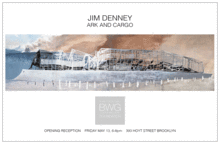
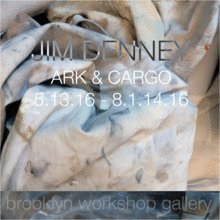
'ARK & CARGO'
OPENING MAY 13, 2016 at Brooklyn Workshop Gallery
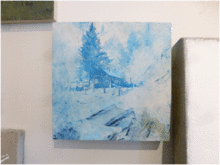
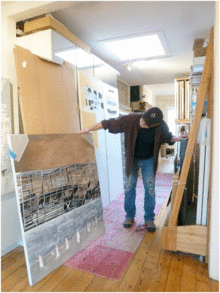
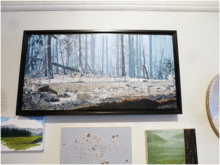
'The Ark glides by on grey silent, oily waters. In the foreground are white ghostly remnants of piers from a long gone industrial presence. A forest surrounding a glaciated peak from a time before humans were in the western hemisphere burns. Billowing plumes of smoke from a wildfire turn into choking brown clouds in front of a blue summer sky. The arks hull appears to be constructed of cedar boards like some ancient Phoenician warship. Its superstructure is a burnt ruin based on the skeletal charred remains of Pier D of the old New York Central railyard. Several years ago this Hudson River structure was determined a navigational hazard and was demolished. Most likely it was considered an eyesore to the residents of the Trump mega development, Riverside South.
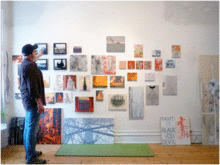
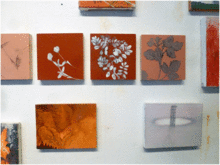
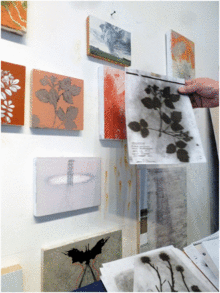
The Ark is empty but in its earliest version it was filled with strange animals, a mutant Noahs Ark. After reading Elizabeth Kolberts The Sixth Extinction I reconsidered. To welcome the Anthropocene, I replaced the cargo of animals with a cargo of ideas represented by the small paintings in the exhibit. These works are an amalgam of my thoughts concerning biology; environmental issues (specific to the Pacific Northwest temperate rain forests where I am from) wild land fires, structure fires, and history- both natural and cultural.
I spend each summer at the headwaters of the McKenzie River, a designated National Wild and Scenic River. It is ironic that my New York home and studio are a few blocks from the Gowanus canal, often cited as Americas most polluted waterway. Fly-fishing the Gowanus may be more psychologically challenging than the McKenzie, but there is the chance I may catch one of those strange creatures I had considered as cargo for the ark.'
Jim Denney May 2016
All of us at Brooklyn Workshop Gallery:Workshop Gallery Artists Foundation welcome these paintings which so sensitively speak of the material history of our city and of the land. We also welcome Mr. Denneys concerns about our environment and the ways in which we collectively address moving forward with a more responsible sense of caring for the earth. 25% of each sale from this exhibit is going towards scholarship funding to the Native American Conservation Corps and the Northwest Youth Corps.
Please join us for the opening on May 13th 6 - 8 p.m.
AN ESSAY BY JIM VERNON ON DENNEY'S WORK:
History Lesson 2016.0
What is history? For Americans, the past is a burden left behind with emigration to the new world. American history has always pointed to the future, to settlement and development of the West mostly. Our national story is a primer of conquest, our manifest destiny to subdue a continent and the Native Americans living there.
There is a deep and permanent version of our history recorded in the American landscape, including changes to the continents natural transportation system, the lakes and rivers used by Native Americans and early explorers to connect north and south, east and west. The once free-flowing waters are now clogged with debris and silt from mining, grazing, logging and irrigated agriculture.
And a large part of our riverine legacy is cast in concrete, with an uncountable number of bridges, shipping locks, irrigation diversions and hydropower structures imbedded in every stream, large or small.
Read this history in the images in Denneys paintings. The simple and stubborn reality of paint and canvas is that, from nature, the same scene cannot be painted twice. Change is fundamental, continuous and irrevocable. Add to this the fact that history is texture as well as chronology, and Denneys paintings become palimpsests of weather and water and soil and trees.
Of course facts have no meanings by themselves; making sense
of the past requires judgment and interpretation. In much the same way, art reflects the history of a time and place and yet exists independent of its creation and circumstance. If we seek answers, both history and art give us a claim to find what we are looking for, to choose what we want to remember. But Denney makes the process difficult for us. He sifts through the past and shifts our perspective so that there are no easy answers. Figures are not set directly against the landscape, but the human imprint is everywhere in the ambiguous, abandoned structures, so amorphous and ephemeral that it is impossible to tell whether they are imperfectly constructed or partially collapsed. The humblest lesson in these paintings is that nature is fragile in any of its particular manifestations. Aside from a few of our more imposing structures, the human communities inhabiting the earth are also fragile. In terms of growth and decline and the long flow of time, we are part of nature, even if opposed to it often in the ways we choose to live.
The raw moral edge in Denneys art poses the same question begged by all good history: How did we arrive in the world we live in?
DO COME VISIT THIS EXTRAORDINARY EXHIBIT. IF YOU WOULD LIKE TO MAKE AN ARRANGEMENT FOR A GROUP VISIT, SCHOOL OR CAMP GROUP, please do contact us in advance. We particularly welcome children's groups and are glad to coordinate some art exercises for these visits.
The exhibit remains through the summer (with variations, additions and guests)
OPEN HOURS through May (please call or visit our FACEBOOK page for additional hours)
Saturdays & Sundays 11 - 7
Mondays closed
Tuesdays and Wednesdays by appointment
Thursdays 1 - 9
Fridays 1 - 7
|
|
 |
LocationWorkshop Gallery Artists Foundation at Brooklyn Workshop Gallery (View)
393 Hoyt Street
Brooklyn, NY 11231
United States
Map is loading...
In order to see the map for this event, click the Privacy icon in the lower left corner of your screen and grant consent for Google Maps.
The Privacy icon looks like this:

Categories
| Kid Friendly: Yes! |
| Dog Friendly: No |
| Non-Smoking: Yes! |
|
Contact
|