|
|
Event
Mark Deutsch
Mark Deutsch - Bio
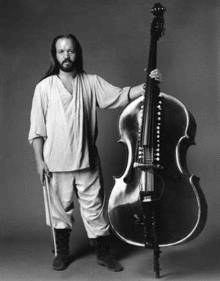
Mark Deutsch can best be described as a 21st century Renaissance man. A professional musician since the age of twelve, he is a visionary artist with a background in non-linear mathematics, sacred systems and cosmology. As a classically trained bassist and sitar player he gained extensive experience in orchestral and world music ensembles, jazz combos, and solo sitar performance. While studying sitar and North Indian classical music with the legendary Ustad Imrat Khan, Mark began delving deeper into the universal fundamentals of music and their underlying frequency structures which also saw him embark on his quest to develop an instrument that could reproduce his findings. This work culminated in 1999 with Mark being awarded the US patent for his ground breaking new instrument the Bazantar - a five-string acoustic bass fitted with an additional twenty-nine sympathetic strings and four drone strings. The result is a remarkable instrument that weaves a mesmerizing soundscape of resonance, and evokes all the power of Western classical music with the depth and nuance of Eastern traditions.
Since the creation of the Bazantar, and the critically acclaimed release of his first solo album "Fool", Mark has been performing extensively world wide. His awe-inspiring solo sitar and Bazantar performances have drawn rave reviews from the international music community and have generated invitations for Mark to perform at the Juilliard School of Music, Merkan Concert Hall, The Hawaiian Contrabass Festival and many other high profile festivals and venues. He is no stranger to film and theatrical composition having written and performed the theatre score for a much lauded French production of Steven Berkoff's adaptation of Poe's "Fall of the House of Usher" and several independent films. On the collaborative side, his music has attracted an eclectic array of some of today's finest musicians, including Grammy award-winning cellist David Darling, film composer David Julyan (Insomnia, Memento), seminal Chicago rock band Tortoise, virtuoso erhu player and principle soloist with the Beijing National Symphony Yang Ying, multi-instrumentalist Jaron Lanier and jazz luminaries such as William Parker, Roy Campbell, and Hamid Drake. Mark currently resides in San Francisco while working on his second solo release.
About The Bazantar
The Bazantar is a five-string acoustic bass, fitted with an additional twenty-nine sympathetic strings and four drone strings. The instrument possesses a melodic range of over five octaves, while its sympathetic range spans four octaves. This results in an interplay between melodic, sympathetic, and drone strings which weaves an unexpected landscape of resonance that is remarkably rich in texture.
In the late 1980s, Mark Deutsch began exploring North Indian classical music. The subtlety of this style, combined with his pursuits on the sitar, inspired him to delve deeper into the study of music. He started exploring the mathematics of sound, particularly music's underlying frequency structure. This search revealed nonlinear mathematical patterns that exist in sound and are found universally in the natural world, including the over-tone series, fractals, the golden mean, seashells, and the Fibonacci series.
In 1993, Mark began work on the first prototype of the Bazantar, an acoustic bass with additional sympathetic and drone strings. His intent was to create an instrument that would take advantage of these nonlinear mathematical patterns and make them more consciously audible. The difficulty lay in engineering a design that would be able to withstand the tension of the additional strings. He devised the unique solution of constructing a separate housing that would contain both the sympathetic strings and their resultant tension, which would then be mounted onto the instrument. After much experimentation, a finalized version was completed in October of 1997.
In this finalized version, the drone strings are positioned outside the Bazantar's lowest melody string on a bass bridge, which has been modified to support this configuration. The sympathetic strings are held in a modular graphite housing that is positioned between the feet of the main bridge and mounted at the bottom of the tailpiece and at the base of the neck, underneath the fingerboard. The torque these strings create is contained within this housing. Because none of this torque is transferred to the instrument's body, the stress to its structure is greatly decreased, allowing for increased flexibility throughout the entire design. The Bazantar's engineering strategy enables it to maintain more strings at higher tensions than conventional approaches dictate. This distinguishes its tonal character and contributes to its powerful and complex sound.
Performance curated by Elektra Schmidt and Artist Migration, an organisation dedicated to the integration and mobility of international artists. www.artistmigration.com
|
|
 |
LocationInternational Festival Lounge (View)
540 Sutter Street
San Francisco, CA 94102
United States
Map is loading...
In order to see the map for this event, click the Privacy icon in the lower left corner of your screen and grant consent for Google Maps.
The Privacy icon looks like this:

Categories
| Kid Friendly: Yes! |
| Dog Friendly: No |
| Non-Smoking: Yes! |
| Wheelchair Accessible: Yes! |
|
Contact
|